


The phone rings. Another lead. But as any seasoned roofing contractor knows, not all leads are created equal and the difference between a $4,000 patch repair and a $35,000 full replacement isn't just the scope of work. It's the entire business model underneath.
Across the industry, a quiet shift is underway. Rather than chasing volume through storm-chasing campaigns and high-volume Google Ads spend, a growing cohort of roofing companies are restructuring their marketing to attract fewer leads at dramatically higher value. The goal isn't more calls. It's the right calls premium replacements, commercial flat roof contracts, and customers who can afford the work without haggling over price.
"Most roofing ad accounts generate volume but not quality," according to Hello.bz's roofing marketing framework. "Hello.bz tightens targeting to premium replacement projects the calls that actually close at margins worth defending."
This isn't a story about ignoring lead generation. It's a story about rethinking what you're actually selling and building a marketing engine that finds the customers who want what you deliver.
Why Volume Marketing Often Costs More Than It Earns
The instinct for most roofing contractors is straightforward: more leads equal more revenue. But the math tells a different story when you trace a lead from first click to final invoice.
Consider the hidden costs embedded in high-volume marketing. A contractor running broad PPC campaigns may generate dozens of inquiries each month, but a significant portion will be price-shoppers, emergency patch seekers, or homeowners whose insurance claims fell through. Each of these leads consumes estimator time, follow-up labor, and proposal preparation costs that don't appear on the marketing invoice but erode margins nonetheless.
"Wrong leads cost more than no leads," according to Hello.bz's analysis of roofing lead quality. "Most roofing ad accounts generate volume but not quality." The publication notes that the real problem isn't volume it's everything around the volume: leads that go to competitors instead of you, leads that want a patch repair when you need $20,000 replacements, and leads that come in January and disappear in April when the weather warms.
The feast-or-famine cycle that plagues so many roofing companies isn't simply a seasonal phenomenon. It's a symptom of marketing strategies built around volume rather than value. When your campaigns attract anyone with a roof leak, your pipeline fills and empties with the rhythms of urgency rather than the steady pulse of planned replacements and commercial maintenance cycles.
The Ticket Size Math That Changes Everything
Here's where the numbers become compelling. A premium residential replacement runs $15,000 to $40,000 or more. A commercial flat roof project can hit $100,000 or beyond. Your marketing return on investment on those deals is fundamentally different from chasing storm-chasing volume work.
"The companies growing sustainably in roofing aren't chasing every lead," according to Hello.bz's high-ticket ROI breakdown. "They're focused. Targeting premium replacements and commercial work means fewer jobs to manage, more revenue per crew, less dependence on storm cycles, and customers who can afford the work."
The operational implications are significant. When you're running premium contracts, you need fewer crews to hit revenue targets. Your estimators can spend more time on detailed proposals because the deal size justifies the investment. Your crews develop expertise on higher-end installations, which improves quality and reduces callbacks. And your accounts receivable stabilizes because commercial clients and affluent homeowners typically have cleaner payment histories than insurance-dependent emergency repairs.
As of 2026, the US roofing industry is projected to be worth over $43.12 billion by 2033, according to HostAdvice's roofing marketing analysis. That growth is being driven substantially by premium replacement activity and commercial construction segments where the marketing playbook looks very different from traditional residential volume work.
What High-Ticket Customers Actually Want
Understanding the psychology of high-ticket roofing customers is essential to marketing effectively to them. These aren't homeowners scrambling to patch a leak before the next rainstorm. They're decision-makers evaluating a significant capital expenditure, often with insurance adjusters, property managers, or board members involved in the process.
"Homeowners making a $15k-$40k decision need confidence, not just a quote," according to Hello.bz's conversion insights. "Reviews, warranty clarity, and crew photos do more conversion work than any discount ever will."
This insight cuts to the heart of high-ticket marketing. When the deal size is large, price becomes secondary to trust. The homeowner isn't asking "Can you do it cheaper?" They're asking "Can I trust you to do this right?" That shift in buyer psychology changes everything about how you present your marketing, your proposals, and your follow-up process.
The same principle applies in commercial roofing. Property managers and facility directors aren't just comparing bids they're evaluating contractor reliability, insurance coverage, crew qualifications, and the likelihood that your company will still be in business when the warranty needs servicing. Your marketing needs to address those concerns directly, not simply list services and pricing.
Marketing Channels That Work for High-Ticket Roofing
Not all marketing channels are equally effective for premium roofing work. Understanding which platforms attract high-intent, high-capacity customers is crucial to allocating your marketing budget wisely.
Search Engine Optimization for Premium Leads
SEO remains one of the most powerful channels for roofing contractors, but the strategy must be tailored to premium intent keywords. Rather than optimizing for "roof repair near me" which attracts price-sensitive emergency work successful high-ticket SEO focuses on terms like "premium roof replacement," "commercial flat roof contractor," and "architectural shingle installation."
"SEO for roofers provides the highest ROI of any competing marketing technique," according to Roofer's Guild's marketing guide. "SEO produces the lowest cost per lead but takes time to implement and develop." The caveat, the guide notes, is that choosing the right SEO agency is critical to long-term success, given the sparse regulations and con artists that dilute the industry.
For contractors willing to invest in long-term organic visibility, SEO offers compounding returns. A page that ranks for "commercial roof maintenance contract" can generate qualified leads for years with minimal ongoing investment, unlike PPC campaigns that stop producing when you stop paying.
Local Services Ads and PPC for Immediate Visibility
While SEO builds long-term equity, paid channels can generate immediate visibility for high-ticket prospects. Google Local Services Ads are particularly effective for premium residential work because they appear at the top of search results with a verification badge that addresses the trust gap inherent in large-ticket decisions.
"Use Google Local Services Ads, PPC search and display advertising, and social media ads targeted to your specific location to put your business in front of homeowners actively seeking roofing services," according to Jobber's roofing marketing guide. The key is targeting specificity narrowing your geographic focus and keyword targeting to reach homeowners in your service area who are searching for premium services rather than emergency repairs.
Referral Programs That Attract Premium Clients
Referrals remain one of the most effective channels for high-ticket roofing work because they come pre-qualified through social trust. When a satisfied premium client refers a neighbor or colleague, they're essentially vouching for your company which addresses the trust gap that makes high-ticket conversions difficult.
"Referrals are still one of the best forms of advertising for your business as they build instant trust and credibility for your roofing company," according to OnTheMap Marketing's roofing lead generation guide. "Consider creating a referral program and encourage your current customers to spread the word about your business."
The guide recommends setting SMART goals for referral programs and identifying specific referral sources current and previous clients, trade partners, real estate agents, and property managers who regularly encounter clients needing roof work.
Building a 12-Month Marketing Calendar for Premium Work
Seasonality is often cited as the primary challenge in roofing, but contractors focused on premium work can use predictable demand patterns as a strategic advantage. The key is pre-positioning your marketing before demand spikes rather than scrambling to generate leads when competitors are also increasing their spend.
"Storm season, spring inspection cycles, and post-winter urgency are predictable," according to Hello.bz's seasonality analysis. "Campaigns that pre-position before demand spikes capture leads before competitors react."
A strategic 12-month marketing calendar for premium roofing work might look like this:
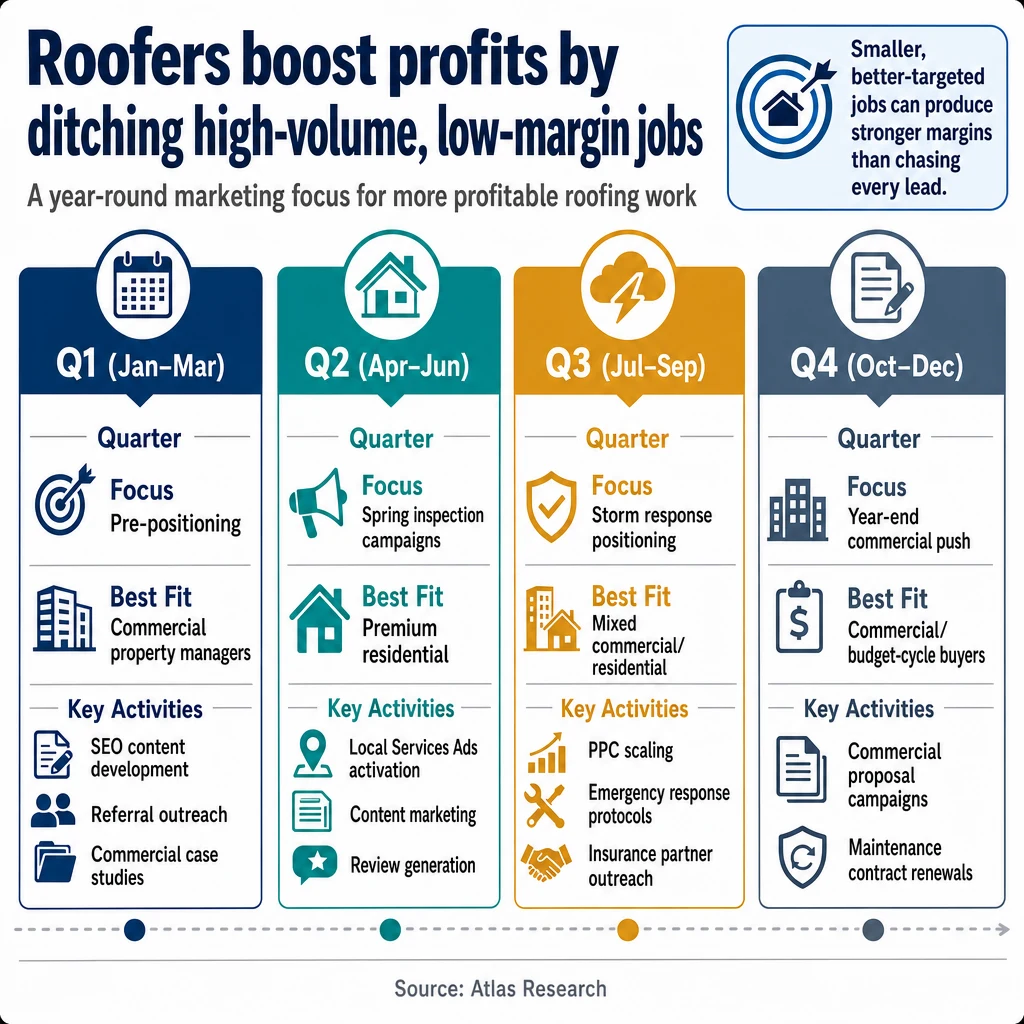
| Quarter | Marketing Focus | Target Segment | Key Activities |
|---|---|---|---|
| Q1 (Jan-Mar) | Pre-positioning | Commercial property managers | SEO content development, referral outreach, commercial case studies |
| Q2 (Apr-Jun) | Spring inspection campaigns | Premium residential | Local Services Ads activation, content marketing, review generation |
| Q3 (Jul-Sep) | Storm response positioning | Mixed commercial/residential | PPC scaling, emergency response protocols, insurance partner outreach |
| Q4 (Oct-Dec) | Year-end commercial push | Commercial/budget-cycle buyers | Commercial proposal campaigns, maintenance contract renewals |
This calendar acknowledges that commercial roofing often follows different seasonal patterns than residential emergency work. Property managers frequently plan roof replacements around fiscal year budgets, making Q4 an opportune time to approach commercial clients with proposals for the following year.
Proof Closes More Than Pricing
One of the most counterintuitive insights in high-ticket roofing marketing is that discounts are often counterproductive. When you're marketing to premium clients, a lower price can actually reduce your conversion rate by signaling lower quality or desperation.
"Proof closes more than pricing," according to Hello.bz's conversion framework. "Homeowners making a $15k-$40k decision need confidence, not just a quote. Reviews, warranty clarity, and crew photos do more conversion work than any discount ever will."
This means your marketing should focus heavily on social proof and credibility signals. Customer reviews on Google and industry-specific platforms like GuildQuality or the Better Business Bureau carry significant weight for high-ticket decisions. Detailed project portfolios showing before-and-after photography of premium installations demonstrate capability. Crew qualification documentation certifications, insurance certificates, manufacturer training addresses the commercial client's risk management concerns.
The investment in collecting and displaying proof pays dividends across the entire sales process. When a premium prospect arrives at your website and sees extensive five-star reviews, detailed project case studies, and clear warranty documentation, the sales conversation shifts from "Are you trustworthy?" to "Let's discuss the project scope."
The Capacity Match: Why More Leads Can Be a Problem
There's an uncomfortable truth that many roofing contractors avoid confronting: more leads can actually harm your business if your capacity isn't structured to handle them profitably.
"Growth doesn't mean burning out your crews in July," according to Hello.bz's growth objection handling. "It means filling winter months. Raising ticket quality. Winning the premium jobs and commercial work that make $500k feel like $500k instead of a lot of stress for the same profit you made at $300k."
This insight reframes the entire marketing conversation. Rather than asking "How do we generate more leads?" the question becomes "How do we generate leads that match our capacity and margin requirements?" A contractor with three crews and a preference for architectural shingle installations shouldn't be running the same marketing as a storm-chasing operation with eight crews and a volume-based margin structure.
The strategic implication is that marketing budget allocation should flow toward the customer segments and project types that align with your operational capacity. If your crews excel at premium residential work but struggle with commercial flat roofs, your marketing should emphasize the former while de-emphasizing the latter even if commercial work appears more lucrative on paper.
What This Means for Hello.bz Readers
For readers evaluating roofing marketing strategies, the shift from volume to value isn't just theoretical it's a practical reorientation of how you allocate marketing resources, build your sales process, and measure success.
The key takeaway is that high-ticket roofing marketing requires a different mindset than traditional lead generation. Instead of optimizing for cost per lead, you're optimizing for revenue per marketing dollar invested. Instead of measuring leads generated, you're measuring lead quality and close rates. Instead of chasing every opportunity, you're targeting the segments where your capabilities match customer needs.
This approach requires patience. SEO takes months to produce results. Review portfolios build over years. Commercial relationships develop through consistent relationship management rather than transactional advertising. But for contractors willing to invest in the long game, the reward is a business that's less dependent on storm cycles, less stressed by seasonal fluctuations, and more profitable per project than the volume-focused competition.
Where to Read Further
For contractors ready to explore high-ticket roofing marketing in more depth, several resources offer detailed frameworks and tactical guidance.
Hello.bz's roofing marketing hub provides a structured approach to gap analysis, lead quality assessment, and 12-month marketing planning specifically designed for contractors focused on premium replacements and commercial contracts.
Jobber's roofing marketing ideas for 2026 offers a comprehensive overview of digital advertising channels, referral program setup, and result tracking methodologies that apply to premium roofing work.
Roofer's Guild's 19 techniques guide provides detailed breakdowns of SEO strategy, email marketing execution, and traditional marketing methods that can support high-ticket lead generation when properly targeted.
The common thread across these resources is that successful high-ticket roofing marketing isn't about doing more it's about doing differently. Different targeting. Different proof. Different conversations. Different metrics. The contractors who master that shift will find themselves with steadier revenue, healthier margins, and a business that's built to last beyond the next storm season.