


The calls are coming in. The website is getting traffic. But when the estimate is done, the number on the page isn't $80,000 it's $12,000, and the prospect is already getting three other bids.
If you've been running Google Ads for your remodeling business and feeling this frustration, you're not alone. The gap isn't in your craftsmanship or your crew. The gap is in how the marketing is built. And the data behind high-ticket remodeling strategy tells a clear story about why most campaigns attract the wrong clients and what actually works when the target is a homeowner ready to invest in a whole-home renovation.
How Do I Get High-Ticket Remodeling Clients?
The first thing to understand is that high-ticket clients aren't hiding. They're searching but they're searching differently than most contractors assume. According to hello.bz's remodeling marketing framework, the leads that come through generic Google campaigns are often price-shoppers who found you because you were the cheapest result for a generic keyword. That's not the client who writes a $90,000 check for a whole-home remodel.
Homeowners ready to invest $50,000, $80,000, or $100,000-plus in their kitchen are looking for portfolios, process explanations, design credentials, and trust signals. They want to understand how the work is structured, who will be in their home for weeks, and why this particular contractor is the obvious choice for their project. These prospects find competitors who learned how to appear at the top of those more specific searches.
The shift isn't about spending more on marketing. It's about building campaigns around the right keywords, the right content, and the right landing pages for homeowners at the top of the market. hello.bz's Google Ads page for remodelers frames it directly: "Your targeting probably is" the issue, not the platform itself. Most campaigns are built around the same keywords every contractor bids on "kitchen remodeler," "bathroom renovation," "home addition" which attracts the most price-sensitive segment of the market: homeowners shopping three bids on a Saturday.
What Is the Best Marketing Strategy for Luxury Home Remodelers?
The best marketing strategy for a luxury remodeler starts with a reframe that most contractors need to hear: more leads is not the goal. That's the opening from Leads4Build's 2025 remodeling marketing guide, which emphasizes that understanding where your remodeling company stands in its growth journey determines which channels and tactics make sense.
For contractors targeting high-ticket clients, the strategy has to be segmented by project type and budget tier. A $6,000 bathroom refresh and a $90,000 whole-home remodel need different messaging, different targeting, and different landing pages. Trying to serve both audiences with the same campaign dilutes the message for the luxury homeowner and attracts the volume chasers who never intended to spend that much.
The marketing guide from OnTheMap's 2026 remodeling marketing tactics recommends starting with a documented strategy that identifies your remodeling company's specific goals and reverse-engineers the demographics and psychographics of the homeowner who needs your service most. For a luxury remodeler, that means targeting based on property value, search behavior around premium design terms, and engagement with content that speaks to high-end project scopes rather than cost-first queries.
How Do You Target Wealthy Homeowners for Home Renovations?
Targeting wealthy homeowners begins with understanding where they start their search and what information they're consuming before they ever contact a contractor. HomeGuide's 2026 home improvement marketing guide notes that homeowners research online, compare reviews, and expect businesses to provide a strong digital presence before they decide. For luxury projects, that digital presence needs to do more than list services it needs to demonstrate expertise, showcase portfolio depth, and explain process in ways that build confidence before the first conversation.
The data from Leads4Build shows that over 55% of homeowners begin their search online, and 78% of mobile searches for remodeling services convert to purchases within 24 hours. For luxury projects, the timeline is longer but the principle holds. The homeowner is doing extended research, and the contractor who appears throughout that research with the right content is the one who gets the call.
Trust is built before the first estimate. hello.bz's approach emphasizes that homeowners selecting a remodeler are choosing someone to be inside their home for weeks. Portfolio depth, review recency, and transparent process descriptions reduce sales friction before contact. For wealthy homeowners making a significant financial decision, that pre-call trust-building isn't optional it's the actual purchase decision, happening before the phone rings.
How Much Should a Remodeling Company Spend on Marketing?
The question isn't how much to spend it's what you're buying with every dollar. The remodeling marketing framework from hello.bz makes the math explicit: three high-ticket projects a month at $80,000 or more equals $2.4 million or more in annual revenue. Twelve medium-price jobs that constantly need attention equal a full schedule with thin margins.
From a pure return-on-investment standpoint, a new customer who comes in through a discount offer costs money over the lifetime of that relationship. A customer who finds you because you're the obvious choice for luxury remodels is worth tens of thousands including the referrals that follow. The cost per lead looks different when you're measuring it against project value rather than lead volume.
The OnTheMap marketing tactics guide recommends determining your budget based on what competitors are doing. If they're executing marketing techniques at the highest level, expect to spend more to compete. But that spend should be allocated toward the channels and keywords that reach high-intent luxury homeowners not broad generic terms that generate clicks without converting into the right kind of inquiry.
How Do You Sell High-Ticket Remodeling Projects?
Selling high-ticket projects starts in the marketing, not in the sales call. By the time a luxury homeowner picks up the phone, they've already done significant research. They've looked at your portfolio. They've read your process descriptions. They've checked your reviews. The sale happens in the pre-call content the website, the portfolio presentation, the blog posts that answer comparison questions early and keep your brand present through the decision cycle.
According to hello.bz, remodeling has the longest consideration cycle in home improvement. That means the marketing needs to answer comparison questions early and keep the brand present through a decision that may take weeks or months. For high-ticket projects, this content-driven approach builds the trust that makes the sales call a formality rather than a persuasion exercise.
BuyerGains's remodeling marketing guide notes that in 2023 the U.S. residential remodeling industry was valued at $527 billion, and to capture a share of that spend, remodelers need a presence where homeowners are already looking: search engines, social media platforms, and local directories. For high-ticket projects, that presence needs to be authoritative and specific speaking to the homeowner's actual project scope rather than generic remodeling services.
What Are the Best Lead Generation Sources for High-End Contractors?
The best lead generation sources for high-end contractors are the channels where luxury homeowners do their research. The HomeGuide marketing guide outlines the core channels: SEO for long-term organic traffic, PPC ads for immediate exposure on high-intent searches, email campaigns to nurture past clients toward referrals, and social media outreach on platforms where before-and-after photos inspire action.
For high-ticket remodelers, the emphasis shifts within these channels. SEO targets not just "kitchen remodeler" but longer, more specific queries around design credentials, process explanations, and portfolio showcases. Google Ads bid strategies focus on keywords that indicate higher project budgets and longer consideration timelines. Content marketing addresses the questions luxury homeowners ask in the research phase which may be months before they're ready to contact anyone.
The Leads4Build guide recommends working with a remodeler marketing agency that specializes in the industry for contractors who want to move faster or lack internal marketing expertise. But whether handled in-house or through a partner, the core requirement is the same: a marketing strategy that understands the difference between a Saturday-morning price-shopper and a homeowner who's been planning their whole-home renovation for six months.
Why Does "Ranking #1" Often Fail High-Ticket Remodelers?
The obsession with ranking #1 for generic keywords is one of the most persistent and expensive mistakes in remodeling marketing. hello.bz's Google Ads page puts it plainly: "Your budget is going toward the wrong eyes." The keyword that gets the most clicks from contractors bidding on it is the keyword that attracts the most price-sensitive homeowners.
Meanwhile, homeowners ready to invest $50,000 or more in their kitchen are searching differently. They're looking for portfolios, process explanations, design credentials, and trust signals. They find competitors who learned how to appear at the top of those searches which requires different content, different targeting, and different landing pages than the generic "kitchen remodeler near me" campaign.
The BuyerGains guide emphasizes that strong reviews on Google and Yelp, combined with an optimized Google My Business profile, build the trust that turns browsers into booked projects. For high-ticket remodelers, those reviews and that digital presence need to speak to quality, process, and expertise not just availability and price.
What Does a 12-Month Marketing Plan Actually Include for Luxury Remodelers?
A practical 12-month marketing plan for a luxury remodeling business includes several components that work together across the consideration cycle. Based on the hello.bz framework, these components include gap analysis (understanding where leads are currently coming from and why they're not converting into high-ticket projects), local visibility (being present in the searches that matter for the geographic area served), website conversion (ensuring the site answers luxury homeowner questions before the call), and lead follow-up (systems that nurture high-intent inquiries through extended timelines).
The OnTheMap guide recommends documenting the entire digital marketing strategy at the start, including the buyer's journey, target demographics, and competitive analysis. For a high-ticket remodeler, this documentation makes it possible to build campaigns that target specific job types and budget tiers rather than chasing volume that never converts to the revenue target.
What this means for hello.bz readers: the difference between a full schedule and a profitable one often isn't more leads it's better targeting. The data from hello.bz's remodeling marketing resources shows that contractors who build campaigns around the right keywords, the right content, and the right audience metrics generate better leads without necessarily spending more. The math on three $80,000 projects versus twelve $20,000 projects is compelling, and the path to that shift is a marketing strategy built for the top of the market, not the middle.
How Does Project Type Segmentation Change the Marketing Approach?
Segmentation by project type and budget tier is one of the clearest differentiators between marketing that generates high-ticket leads and marketing that generates volume. The hello.bz remodeling marketing page describes this as foundational to their approach: "A $6k bathroom refresh and a $90k whole-home remodel need different messaging, different targeting, and different landing pages."
This segmentation affects every channel. SEO content targets different keywords and questions for different project types. Google Ads campaigns are structured around different audiences and bid strategies. Portfolio presentations emphasize different aspects of the work. The homeowner searching for a luxury kitchen renovation is looking for different signals than the homeowner looking to update a powder room on a budget and the marketing needs to speak to each one specifically.
The Leads4Build guide categorizes remodeling businesses by stage and type, noting that contractors at different points from solo operators working from their truck to design-build firms managing multiple crews need scalable marketing ideas that match their capacity and target market. For luxury remodelers, that scalability means building systems that can support the extended timelines, higher touchpoints, and more detailed pre-call content that high-ticket projects require.
What Role Does Trust Play in Converting Luxury Homeowner Leads?
Trust is the currency of high-ticket remodeling. hello.bz's approach describes this explicitly: "Homeowners selecting a remodeler are choosing someone to be inside their home for weeks. Portfolio depth, review recency, and transparent process descriptions reduce sales friction before contact." For a $90,000 project that will take months and disrupt daily life, the decision to hire is fundamentally a decision to trust.
The HomeGuide marketing guide notes that businesses need a thoughtful and modern approach to gain leads and turn them into customers. For luxury projects, that thoughtful approach includes detailed process explanations, portfolio showcases with real project stories, and review profiles that demonstrate consistent quality over time. The homeowner who's been researching for months wants to see evidence that this contractor has done this before and done it well.
The BuyerGains guide emphasizes that establishing credibility through well-structured content and strong reviews builds the trust that converts browsers into booked projects. For high-ticket remodelers, that trust-building happens in the marketing before the first estimate, before the contract, before the demo. The contractor who gets there first with the right content is the contractor who gets the call.
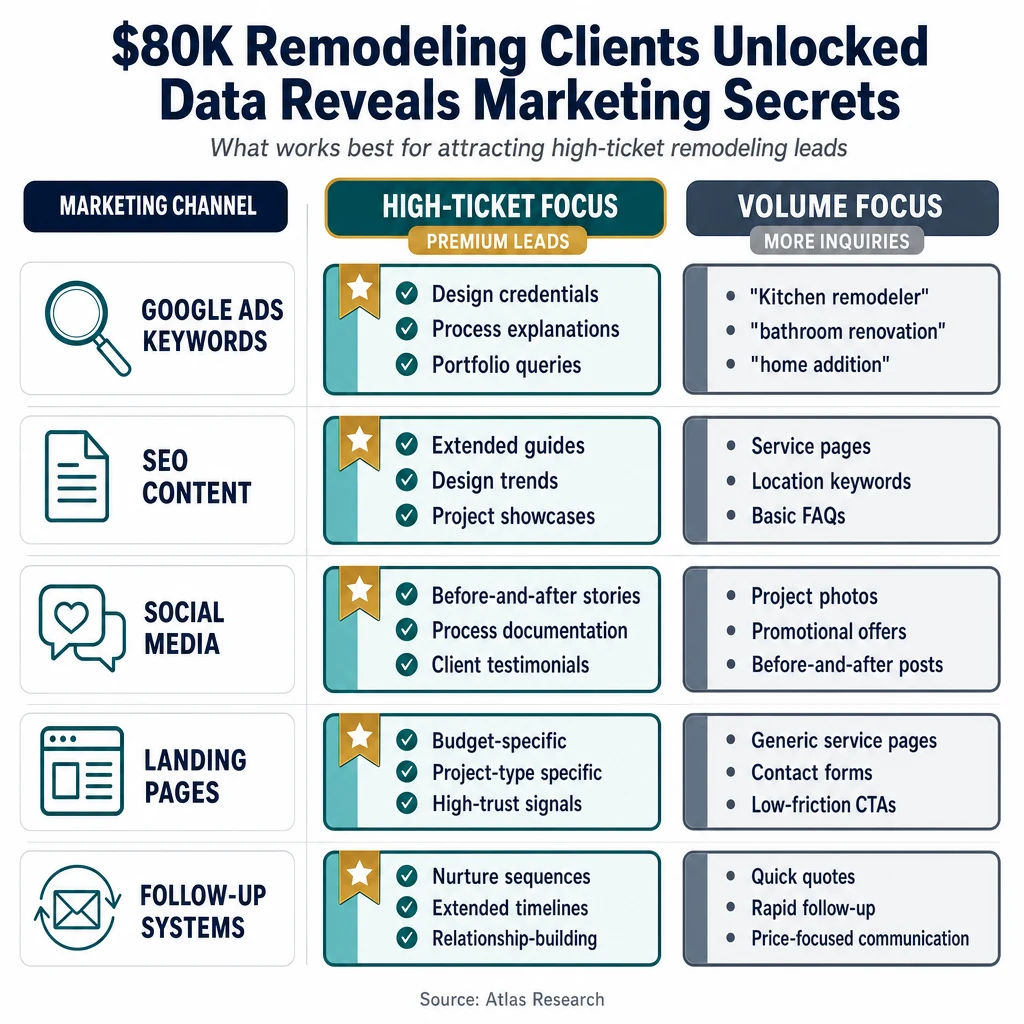
| Marketing Channel | High-Ticket Focus | Volume Focus |
|---|---|---|
| Google Ads Keywords | Design credentials, process explanations, portfolio queries | "Kitchen remodeler," "bathroom renovation," "home addition" |
| SEO Content | Extended guides, design trends, project showcases | Service pages, location keywords, basic FAQs |
| Social Media | Before-and-after stories, process documentation, client testimonials | Project photos, promotional offers, before-and-after posts |
| Landing Pages | Budget-specific, project-type specific, high-trust signals | Generic service pages, contact forms, low-friction CTAs |
| Follow-Up Systems | Nurture sequences, extended timelines, relationship-building | Quick quotes, rapid follow-up, price-focused communication |
Where to Read Further
For contractors ready to dig deeper into the specifics of remodeling marketing strategy, the following resources offer detailed frameworks and data:
- The hello.bz remodeling marketing overview covers the complete framework for targeting homeowners ready to invest $80,000 or more, including the 12-month plan components and gap analysis approach.
- The hello.bz Google Ads page for remodelers breaks down why generic keyword targeting fails luxury contractors and what the alternative looks like in practice.
- The Leads4Build 2025 remodeling marketing guide provides a comprehensive overview of digital marketing channels, business stage considerations, and the data behind where homeowners start their searches.
- The OnTheMap 2026 remodeling marketing tactics covers the full range of digital marketing strategy documentation, competitor analysis, and channel selection for contractors at different growth stages.
- The HomeGuide home improvement marketing guide outlines the specific channels and content approaches that work for connecting with today's research-first homeowners.
- The BuyerGains remodeling marketing guide offers a contractor-focused breakdown of the $527 billion U.S. residential remodeling market and how established contractors position themselves for sustained growth.